
Do you recognise yourself?
Situations of the ones everyone counts on.
They have one thing in common: what you offer others (your time, your attention, your leniency, your protection), you refuse yourself. Here are some of them, grouped by theme. Keep the ones that speak to you.
01 / 08
You say yes to everything
Yes to others, no to yourself
The yes comes out before you have checked whether you can, or whether you want to.
- At 6 pm on a Friday, you take on an urgent file when your week is already overflowing.
- You look after your sister’s children on the only Saturday you had kept for yourself.
- You say “no problem”, then stew over your irritation all evening.
You, last on the list
Your time is what gets adjusted.
- Your sports session is the first thing you cancel when things get busy.
- You’ve been putting off your own medical appointment for months, but you go with your father to all of his.
- You answer the team on Sunday evening so they won’t be stuck on Monday.
What changes
You say yes when you want to, and no without justifying yourself. Your time counts too.
02 / 08
You keep everything to yourself
Others’ needs guessed, yours unspoken
You wait for someone to guess.
- You see straight away when a colleague isn’t doing well; nobody sees that you’re at the end of your rope, and you don’t say it.
- You hope your partner will offer to take over, without asking them.
- Your messages start with “Sorry to bother you, it’s just about…”.
Your opinion kept to yourself
You protect the atmosphere rather than speak up.
- In meetings, you disagree, but say nothing so as not to rock the boat.
- You’ve been putting off the conversation about your workload or your salary for months.
- In the evening, you replay the conversation with the words you didn’t say.
What changes
You say what you need and what you think, even when it isn’t comfortable.
03 / 08
You carry everything
“Without me, it will fall apart”
You believe you are indispensable, and everyone confirms it.
- You don’t go on leave until everything is wrapped up, and nothing is ever wrapped up.
- When you’re ill, you log on anyway, just for the meeting.
- You’ve been the association’s treasurer for eight years, because nobody else will take over.
Doing things in other people’s place
It’s quicker, better done, less risky.
- You redo the work you had delegated.
- Someone confides in you: you immediately look for the solution, and still think about it at night.
- You look after your elderly parent alone, without asking your siblings.
What changes
You let others do their share, and discover that everything holds, even without you.
04 / 08
You hold on, until it spills over
You never show that you’re struggling
You hold on, so others can lean on you.
- During a bereavement, you handle the paperwork and the family; you haven’t cried yet.
- During a reorganisation, you reassure the team while fearing for your own job.
- You cry in the car before going home, so nobody sees.
Set aside until it overflows
What you don’t feel in the moment comes out later.
- You build up without saying anything, then explode over a stray sock.
- You come home loaded with a loved one’s anxiety, and sleep badly.
- A little voice thinks “after everything I do for them”, without ever saying it.
What changes
You feel what is happening inside you as it happens, and you can say it before it spills over.
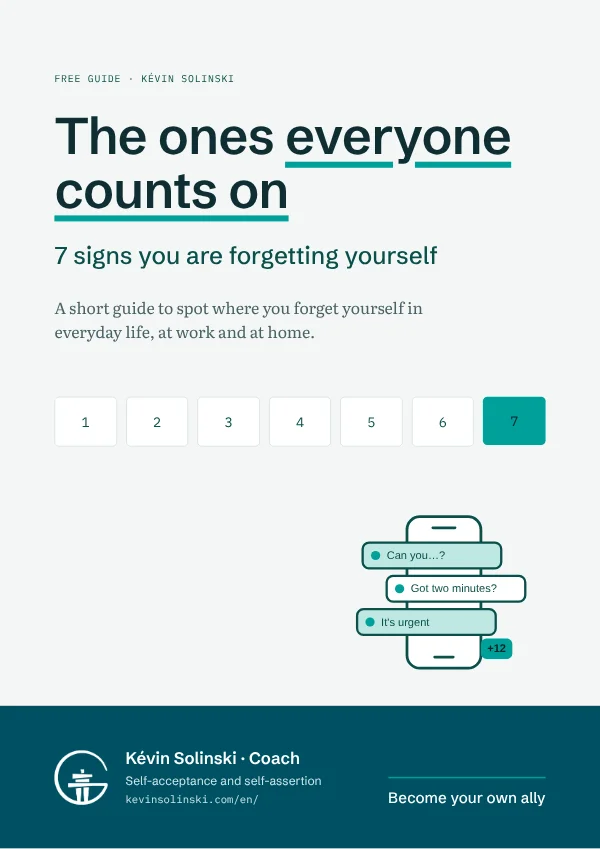
To start on your own
The ones everyone counts on: 7 signs you are forgetting yourself
A short, free guide to spot where you forget yourself day to day.
05 / 08
You are hard on yourself
Lenient with others, relentless with yourself
A standard you wouldn’t impose on anyone.
- To a friend who made a mistake, you say “you did your best”; to yourself, “you’re useless”.
- You chew over one clumsy sentence all weekend.
- You never celebrate a success: you go straight on to the next one.
The guilt of thinking about yourself
Taking time for yourself feels like selfishness.
- One weekend on your own, and you feel you are stealing time from your family.
- When you rest, you feel useless.
- You wait until you’re exhausted before asking for help.
What changes
You talk to yourself as you would to someone you love: with high standards, and with kindness.
06 / 08
You no longer listen to your tiredness
Ignored signals
Your body is speaking; you’ll listen later.
- You hold on until the holidays, and fall ill on the first day.
- Back pain, migraines, broken sleep: you put it down to a busy period.
- You sleep five hours a night, until things calm down.
What changes
You notice tiredness early, and rest before you fall ill.
07 / 08
You no longer know what you want
Existing through being useful
You feel in your place when people need you.
- When nobody needs you (holidays, children gone, sick leave), you feel empty.
- When someone asks “And you, what do you want?”, you have no answer.
- A compliment or a gift makes you uncomfortable.
Adjusting to others
To the point of no longer knowing what you want.
- The restaurant, the film, the holiday: you choose what will please others.
- You set your mood by the mood in the room.
- You’re no longer quite sure what you like.
What changes
You know what you want, and you exist beyond what you do for others.
08 / 08
Your wishes are on hold
Projects “for later”
Your wishes wait until others no longer need you.
- Your career change is waiting until the children are grown up.
- The book, the journey or the training you dream of has been waiting for ten years.
- You turn down an opportunity because the team wouldn’t manage without you.
Staying out of loyalty
Duty comes before what you want.
- You stay in a job that wears you down because your team counts on you.
- You accept a promotion you don’t want, so as not to disappoint.
- You keep a volunteer commitment that exhausts you, out of a sense of duty.
What changes
Your wishes find a place in your decisions again, without letting down the people who count on you.
What now?
Did you recognise yourself in several situations?
It isn’t a lack of willpower: it’s a way of being that protected you for a long time. The aim isn’t to be there less for others. It’s for you, too, to be able to count on someone. Starting with yourself. Telling yourself that others need it more than you do? That is often exactly the sign that it’s time to think of yourself.